
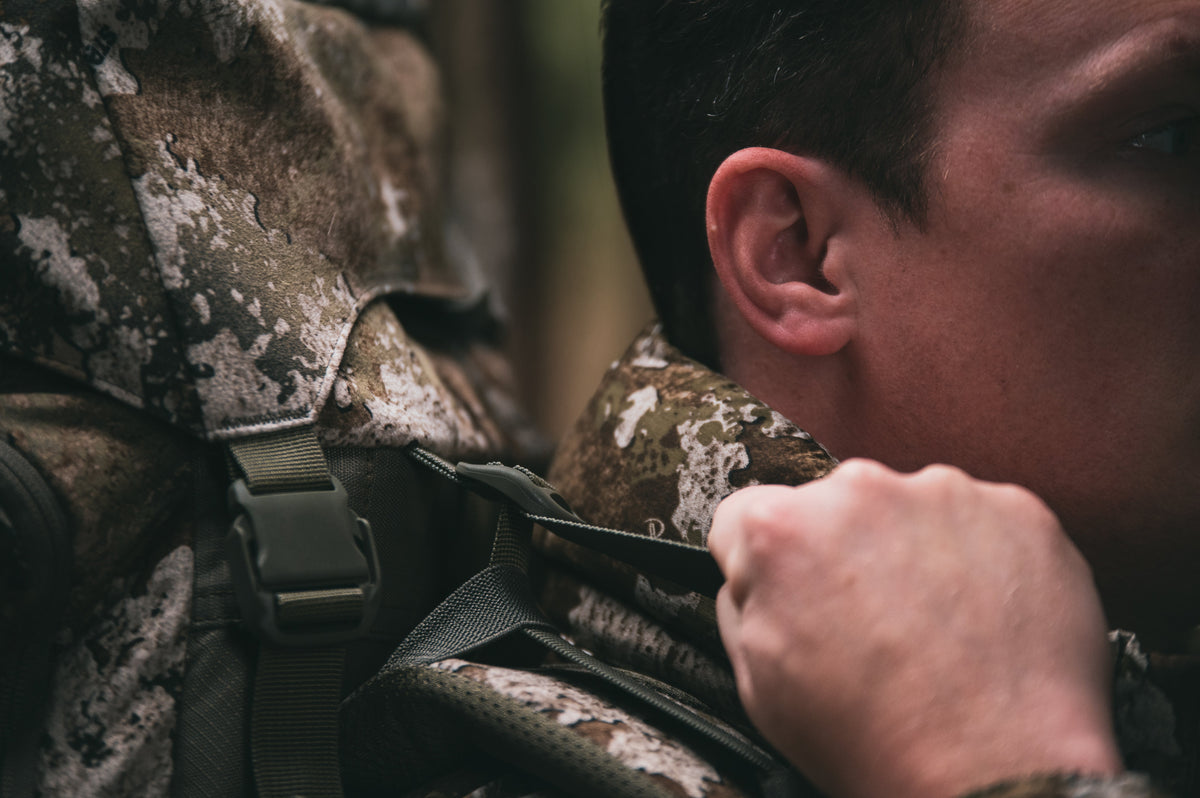
Early bow season has a way of making small sounds feel very big. A branch brushes your pack. A zipper pull taps against hardware. A rangefinder shifts inside a pocket. A loose strap catches a briar. None of these sounds seems significant back at the truck, but during a close-range stalk, unnecessary noise can work against an otherwise careful approach.
That’s why a quiet hunting pack isn’t defined by a single “silent” fabric. Noise can come from the pack shell brushing against cover, a zipper being opened, loose hardware tapping together, gear shifting inside a pocket, or a bulky setup catching vegetation as you move. Even a quiet piece of equipment can become noisy when it’s packed poorly or constantly needs to be adjusted.
During early-season scouting and bowhunting, think of silence as a system. Pack materials, closures, organization, profile, fit, and your own movements all need to work together. A useful way to evaluate that system is through four common sources of unwanted field noise: RUB → CLICK → RATTLE → SNAG
1. Start With a Sound Audit, Not a Spec Sheet
Before debating fabrics, zippers, or pocket layouts, test the equipment you already have. Load your hunting backpack exactly as you plan to carry it. Put on your early-season hunting layers. Attach your usual accessories. Then move the way you actually move in the field: walk, crouch, turn sideways,duck beneath an imaginary branch, open and close a pocket, check the wind.
Listen carefully throughout the process. Identify sounds before entering the woods. That kind of pre-hunt sound check can reveal problems that aren't obvious when equipment is sitting on a table.
Listen specifically for four things:
· Rub is the sound of fabric moving against your clothing, itself, or surrounding vegetation.
· Click comes from zippers, zipper pulls, buckles, snaps, and other hardware.
· Rattle happens when hard objects, accessories, or loose equipment contact one another.
· Snag occurs when straps, gear, or the pack itself catches vegetation and makes noise as you continue moving or pull free.
The objective isn't absolute silence. Movement through real terrain inevitably creates some sound. The goal is to identify avoidable noise and remove as much of it as practical before the hunt begins.
2. RUB: Listen to the Fabric, Not Just the Fabric Claim
For quiet bowhunting gear, exterior material matters because it is the part of your pack most likely to interact with everything around you. Different surfaces produce different sounds when they flex, rub against clothing, or contact brush. This is especially relevant when you're moving through thick early-season hunting cover.
Instead of simply reading a product description that says “quiet,” test how the material behaves. Rub it against your hunting clothing. Flex an empty section of the fabric. Then load the pack and repeat the test. Brush it against representative vegetation where safe and practical. Crouch and twist while wearing it.
The important question isn't simply: is this a quiet fabric? It's: how quiet is this material during the movements and contact I'm likely to create in the field? That distinction matters because fabric is only one component of the noise-control system.
3. CLICK: Small Closures Can Make a Big Difference
Think about the moment when you are most likely to open a pocket during an early bow hunt. It probably isn't when you're casually standing beside the truck. It might be when you've stopped to check the wind.
When you need your rangefinder. When you need to access a small piece of equipment without taking your eyes off the surrounding cover. That's why quiet zipper and closure design deserves more attention than it usually receives.
Zippers themselves aren't automatically a problem. The question is how they're constructed, where they're positioned, what the pulls can contact, and how much movement is required to operate them. Features such as rubberized zipper pulls and reducing exposed metal-to-metal contact when designing for quieter bowhunting movement.
So don't reduce the buying decision to zipper versus no zipper. Ask more practical questions. Can you operate the closure deliberately without wrestling with it? Does the zipper pull strike another hard component while walking? Can you access a high-use pocket without first moving another piece of equipment? Do buckles or pulls hang freely when you're moving?
Every extra action creates another opportunity for movement and sound. A useful closure doesn't just keep gear contained. It lets you access that gear with fewer unnecessary movements.
4. RATTLE: The Quietest Fabric Can't Fix a Noisy Load
You can choose a soft exterior and thoughtfully designed closures and still end up carrying a noisy pack. Put a rangefinder, keys, hard accessories, calls, and other loose equipment together inside one oversized pocket, and the problem has simply moved from the outside of the pack to the inside. Loose gear and unsecured strap ends among the sources of hunting-pack noise.
This changes how you should think about hunting pack organization. For general scouting efficiency, the goal is: put things where you can reach them quickly. For silent movement, add a second requirement: put things where they can't create unnecessary noise.
Separate hard objects when practical rather than letting them knock together. Secure small equipment instead of allowing it to migrate through an oversized compartment. Manage dangling strap ends and zipper pulls. Give frequently used items consistent locations so you don't have to rummage through the pack.
That last point is easy to underestimate. Imagine stopping to check wind and realizing the wind checker could be in one of three pockets. Now you're opening compartments, moving gear, feeling around, closing pockets, and trying another one.
Organization has become a stealth issue. When everything has a predictable home, you reduce both searching and sound.
5. SNAG: Keep Your Hunting Pack Inside Your Profile
The next source of noise isn't something the pack necessarily produces on its own. It's the contact the pack creates with the environment. Avoid contact with branches, vines, and briars is one way to reduce noise while moving through cover.
Apply that principle to your pack. A bulky load with equipment protruding from multiple sides gives surrounding vegetation more opportunities to make contact. So do loose straps, dangling accessories, and poorly secured gear.
This is where low-profile hunting pack design becomes part of field stealth rather than simply an ergonomic preference. Keep the load contained when possible. Tighten or secure unused strap ends. Avoid attaching equipment externally simply because there is an attachment point available. Compress partially filled compartments when the pack allows it.
Think carefully about where externally carried equipment sits relative to your body. The goal is to minimize the number of objects extending into the vegetation around you. A simple rule captures the idea: the quietest branch contact is the one that never happens.
6. Don't Ignore Fit: A Moving Pack Can Become a Noisy Pack
Pack fit is usually discussed in terms of comfort. For bowhunting, it can also affect noise. Imagine ducking beneath a limb and feeling your pack shift. You straighten up, reach behind yourself, pull the shoulder strap back into place, and continue.
That adjustment may involve fabric rubbing against clothing, hardware moving, gear shifting, or your body contacting nearby vegetation. The same thing can happen when crouching, side-stepping through cover, or preparing to draw.
More adjustment means more movement. More movement creates more opportunities for sound. A properly adjusted hunting pack should therefore ride securely and predictably for the movements you expect to make. Test that before opening day. Walk with it. Climb with it. Crouch. Turn. Reach. Practice drawing your bow safely while wearing the complete system and make sure the pack and straps do not interfere with your normal shooting motion.
The goal isn't to claim that good ergonomics make a hunter silent. It's more practical than that: A stable pack reduces the number of unnecessary corrections you have to make while moving.
Silent Movement Is a System
Early-season scouting and bowhunting put a premium on deliberate movement, particularly when the distance closes and every unnecessary action becomes more noticeable. That's why there is no single feature that makes quiet hunting gear truly quiet in the field.
Silence is the result of reducing unnecessary contact throughout the system. A quieter exterior reduces rub. Thoughtful closures reduce clicks. Secure organization reduces rattles. A contained, low-profile setup reduces snags. A stable fit reduces the adjustments that can create all four.
But equipment is only half of the equation. The hunter still has to know where everything lives, control each movement, and practice using the complete setup before entering the woods. Because when a close-range opportunity develops, the best gear isn't the gear you have to think about. It's the gear that lets you focus on your next move, not the noise behind it.
Early-Season Scouting Gear: How to Pack for All-Day Efficiency
Weather-Resistant Hunting Basecamp: High Wind & Fall Rain Setup Guide