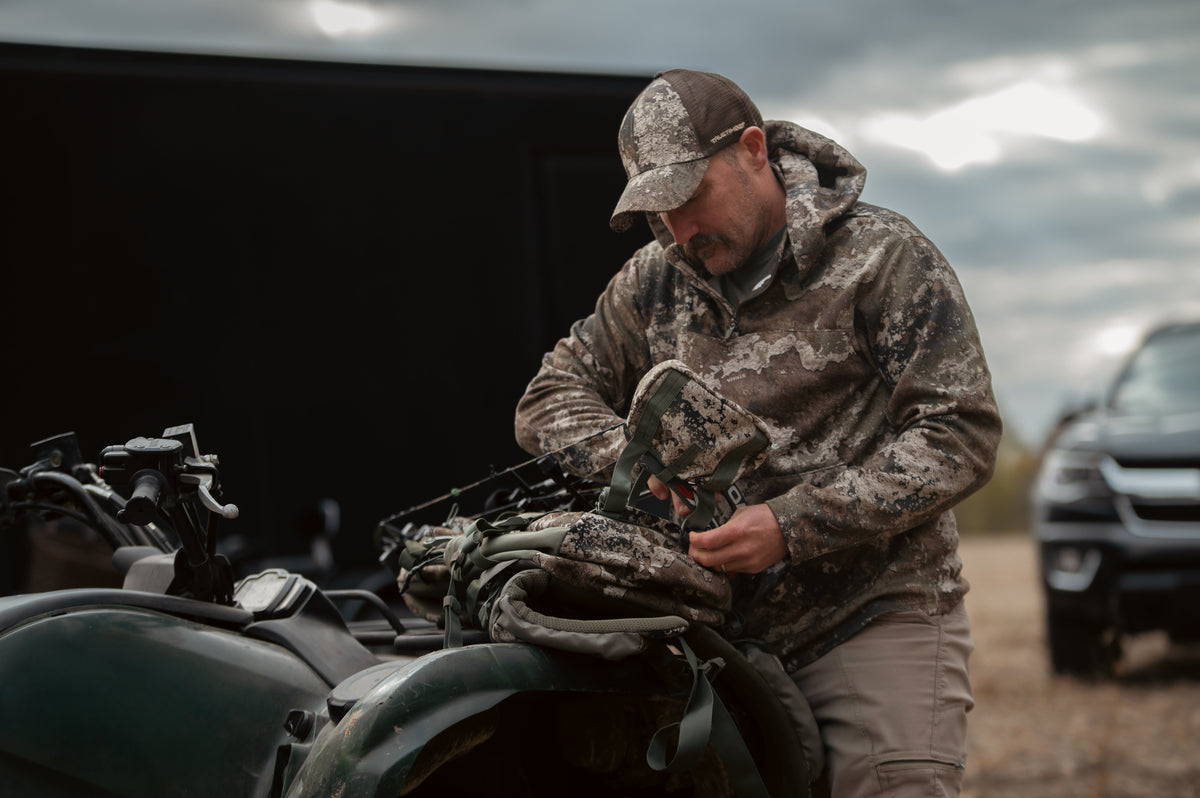
Every extra item has to be carried. Every buried item has to be found. And every loose item has the potential to make noise. That’s why early-season scouting efficiency starts long before you reach your first glassing point.
When you're covering ground, checking wind, stopping to glass, adjusting layers, and moving again, your pack shouldn't become another thing you have to manage. Early-season hunting rewards mobility and deliberate gear choices. Unlike colder hunts that may require bulky insulation, early-season scouting often gives you an opportunity to travel lighter, as long as you resist filling the extra space simply because it's available.
The goal isn't to carry everything you might possibly need. It's to carry exactly what the scouting mission requires and know where everything is when you need it. Whether that means a streamlined Forge Creek® Icon Pro Waist Pack for a shorter scout or a Forge Creek® Icon Pro Day Pack for an all-day outing, the same principles apply: reach what you need, shed what you don't, secure what you carry, and eliminate unnecessary bulk and movement.
1. Start With the “Does It Earn the Weight?” Rule
Packing lighter doesn't mean leaving important equipment behind. It means making every item justify the space and weight it takes up. Before loading your early-season hunting pack, lay everything out: Optics. Wind checker. Rangefinder. Water. Navigation essentials. Food. Rain protection. Extra layers. Gloves. Hat. Spare batteries. First-aid and other necessary field essentials.
Then ask one question: does it earn the weight? Will you realistically use it on this particular scout? Does it solve a likely problem?
Early-season hunting typically requires less clothing and equipment than colder conditions, making a streamlined load possible. The temptation is to use that extra room for another layer, another gadget, and another backup. But those small additions become the load you'll carry mile after mile.
A two-hour scout close to the vehicle and an all-day trek into deeper country shouldn't start with the same pack. Let the mission determine the load, not the available capacity of the bag.
2. Pack by Access Frequency, Not Just Gear Category
Once you've decided what deserves to come, decide where it belongs. One of the simplest ways to improve hunting pack organization is to stop thinking only in categories, optics here, clothing there, and start thinking about access frequency.
Divide the load into three working zones.
Quick-Access Zone: This is for equipment you expect to reach for repeatedly: binoculars, rangefinder, wind checker, lens cloth, navigation essentials
Transition Zone: This is where changing early-season conditions come into play. Keep a removable layer, rain protection, and gloves somewhere you can reach without dismantling the entire load.
Reserve Zone: Less frequently used backup and emergency items can live deeper in the pack. You still know exactly where they are, but they don't compete for valuable quick-access space with equipment you're using repeatedly.
3. Pack for Silence Before You Pack for Space
A scouting pack can be perfectly organized on the garage floor and still be poorly organized for the woods. Because organization isn't only about finding things. It's also about how much movement and noise finding those things requires.
Loose straps can move around. Hard objects can knock against each other. Gear can shift inside partially filled compartments. And every time you stop to dig through everything, you create more unnecessary movement.
Before the season, empty your hunting pack completely. Remove last year's wrappers and forgotten equipment. Check straps, zippers, attachment points, and frequently used pockets.Then rebuild your layout intentionally.
Keep hard items from contacting each other when practical. Secure equipment that tends to shift. Keep frequently used tools in predictable locations so you're not repeatedly opening compartments and moving other gear out of the way.
Once everything is loaded, put the pack on, crouch, reach for your wind checker, access your optics. If the system only works when you're standing still beside the vehicle, it isn't finished yet. The best mobile systems become quiet and repeatable because everything has a place, and that place stays consistent from one scouting trip to the next.
4. Pack for Movement, Not Maximum Capacity
Once the load grows, organization alone isn't enough. Where the weight sits matters too.
Think about two packs carrying the same amount of weight. In one, dense items sit close to your body and the load remains compact. In the other, heavier items sit farther away and loose equipment shifts as you move. The scale may show the same number. Your body may not experience the two loads the same way.
For a daypack, place denser gear closer to your body when practical while allowing lighter or more compressible equipment to occupy space farther out. Then use compression to help keep the load compact rather than letting it expand away from you. This becomes especially useful with the Icon Pro Day Pack, which includes side compression straps for securing extra gear.
The same principle applies to partially filled compartments. Don't let equipment bounce around simply because there is extra room. Compress and secure the load so it moves with you as you climb, crouch, cross uneven ground, or transition between glassing locations. A streamlined scouting setup isn't just light. It's stable
5. Match the Pack to the Scouting Mission
A good pack system doesn't begin by asking, How much can I carry? How much does this outing actually require?
That's where the Forge Creek® Icon Pro Waist Pack and Forge Creek® Icon Pro Day Pack can serve two very different early-season scouting strategies.
Short Scout: Go Fast & Light With the Icon Pro Waist Pack
For a shorter scouting loop, quick morning glassing session, or outing where you remain relatively close to the vehicle, carrying a full daypack may be more system than you need. The Forge Creek® Icon Pro Waist Pack keeps the setup intentionally compact.
With a 5L/300 cu. in. capacity, the waist pack includes a main compartment with a center divider and interior organization, dual zippered accessory pockets, a central shove pocket, oversized hip belts with mesh and zippered bottle or accessory storage, plus exterior lashing points, D-rings, and compression straps.
Put your wind checker, rangefinder, lens cloth, and other frequently used small essentials where they're immediately accessible. Keep optics protected but ready to use rather than buried. Use the main or shove-pocket space for a compact layer, gloves, face covering, or other mission-specific equipment as conditions and available space allow. And use the hip-belt storage for the smaller items you want to reach without constantly opening the main compartment.
All-Day Scout: Extend Your Range With the Icon Pro Day Pack
Now change the mission. You're leaving early. You're covering considerably more ground. Temperatures may change over the course of the day. You'll need more water and food. A layer you need while glassing could spend much of the hike inside the pack.
That's when the Forge Creek® Icon Pro Day Pack becomes the more appropriate system. Its 26L/1,500 cu. in. capacity provides significantly more room, but the important point isn't simply more storage. It's what that storage allows you to do.
The Day Pack has two spacious compartments, a quick-access front compression pocket, large side mesh pockets, removable padded hip belts with zippered accessory pockets, and side compression straps. That architecture makes it possible to separate frequently used equipment from layers, hydration, food, and other gear needed to extend the scouting day.
The additional capacity isn't permission to pack more stuff. It's room for the things that let you stay in the field longer: Water. Food. Changing-weather protection. Layers. Necessary safety and navigation equipment. Your glassing tools still need to remain readily accessible. Your wind checker still needs a permanent home. The difference is that the daypack gives you room for the supporting equipment required when a two-hour scout becomes an all-day trek.
The Best Scouting Pack Is the One You Don't Have to Think About
Early-season scouting is already work. You're covering ground, studying terrain, watching conditions, checking wind, glassing likely areas, and making decisions that may shape the hunts ahead. Your pack shouldn't add another layer of work.
For a shorter, focused mission, the Forge Creek® Icon Pro Waist Pack provides an access-first system that encourages you to stay light and keep frequently used equipment close. For a longer outing, the Forge Creek® Icon Pro Day Pack adds the capacity and organization needed for water, food, changing weather, and layers while still allowing frequently used scouting gear to have a predictable place.
Whichever system matches the mission, remember the same principles: Carry what earns the weight. Put frequently used gear where you can reach it. Secure the load so it stays compact and quiet. The best scouting pack isn't the one that carries the most. It's the one that lets you move, stop, check wind, glass, adjust, and move again without wasting motion or attention on your gear.
How to Clean and Maintain a Hunting Backpack After the Hunt
Quiet Hunting Gear: How to Reduce Pack Noise for Early Bow Season